
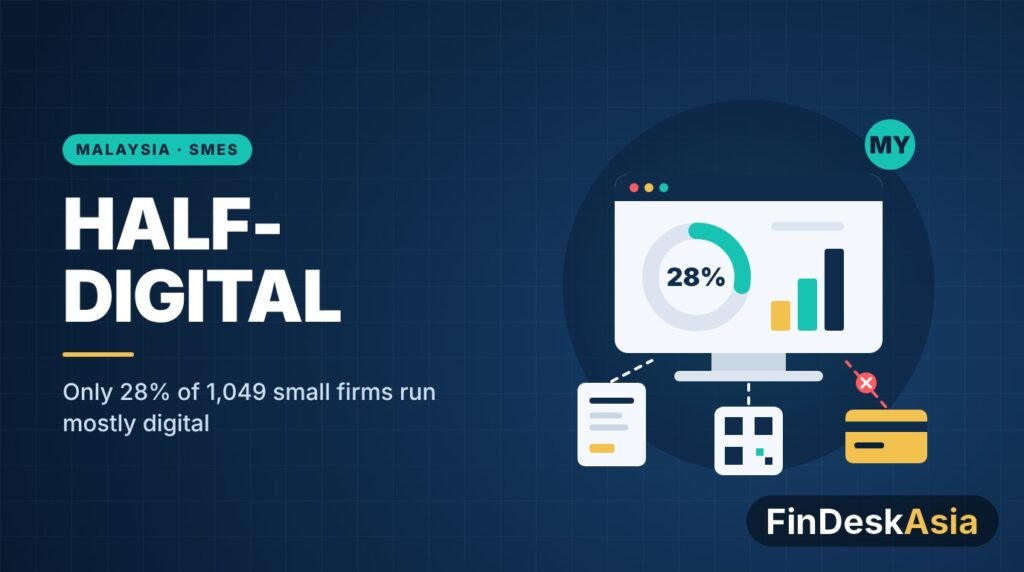
Only 28% of Malaysian SMEs Run Mostly Digital, Xero Survey of 1,049 Firms Finds
Most small businesses in Malaysia now use some digital tools, but only a minority say their operations actually run mostly online. A new survey of 1,049 micro, small and medium enterprises (MSMEs) by accounting software company Xero finds that just 28% describe their business as mostly or fully digital, even as 77% plan to spend more on technology over the next year.
Key facts
- Xero surveyed 1,049 Malaysian MSMEs for its report Turning Digital Progress Into Business Value: The State of Digital Maturity Among Malaysia’s MSMEs, released on 18 November 2026.
- 28% say their operations are mostly or fully digital, 46% run a mix of digital and manual processes, and 26% are still mostly or entirely manual.
- 77% plan to increase technology spending in the next 12 months.
- Only 35% have a clear view of their cash flow, and just 21% can see an accurate financial overview in real time.
- 41% name compliance requirements, including Malaysia’s e-invoicing rollout, as a reason to invest in technology.
Tools in place, but not joined up
The survey suggests the problem is less about whether businesses have software and more about whether that software talks to each other. Digital tools are common in IT (used by 79% of respondents) and in finance and accounting (77%). Yet only 17% keep their financial information in a single, immediately accessible digital tool. Another 27% pull figures from several platforms, and 21% still rely on manual sources such as spreadsheets.
That fragmentation shows up in how well owners understand their own numbers. Only 39% say they have direct visibility of revenue and profitability, and roughly one in ten have no direct view of their business finances at all.
Koren Wines, Managing Director of Xero for Asia-Pacific, said many firms are moving day-to-day work such as handling payments and invoicing, tracking expenses and managing customers onto digital tools. The next step, in Xero’s view, is getting those tools to work together so owners see the whole business in one place.
What is driving the spending
Customer expectations are the top reason to invest, cited by 53% of firms, followed by the need to cut costs or work more efficiently (52%). Compliance is the third driver at 41%. In Malaysia, a big part of that is e-invoicing: the Inland Revenue Board of Malaysia (LHDN) has been phasing in electronic invoices, which pushes businesses to issue and store invoices in a digital, machine-readable format rather than on paper or PDF.
Artificial intelligence (AI) is also spreading. 44% of respondents say they actively use AI, either across several functions or in specific areas, and another 22% are piloting or testing AI tools. The biggest worries holding businesses back are privacy and security risks (43%), a lack of skills and expertise (36%) and the cost of implementation (34%).
What it means for Malaysians
- For SME owners: the gap is visibility. A business that collects payments through DuitNow QR, card terminals and e-wallets but reconciles them by hand in a spreadsheet will struggle to see its real cash position. Linking payment, invoicing and accounting systems is where the survey points to the biggest gains.
- For banks and fintechs: only about a third of MSMEs have a clear view of their cash flow. Lenders that rely on clean financial data to approve SME credit, and payment providers that offer built-in bookkeeping or reconciliation, have a large market still to serve.
- For policymakers: Xero links the findings to national plans such as the Thirteenth Malaysia Plan and the Malaysia Digital Action Plan 2030, arguing that their goals depend on MSMEs getting the skills, systems and support to turn tech spending into results.
What to watch
- Whether the e-invoicing rollout pushes more small firms to connect invoicing directly with payments and accounting, rather than adding another standalone tool.
- How banks and payment providers respond with bundled tools for SMEs, such as automatic reconciliation of QR and card payments.
- Whether privacy and security concerns, the top barrier at 43%, slow adoption of AI and cloud tools among smaller firms.
Related on FinDeskAsia: Payment gateways in Malaysia explained and DuitNow explained.
Sources: Tech Critter (November 2026); ProductNation (November 2026).
