
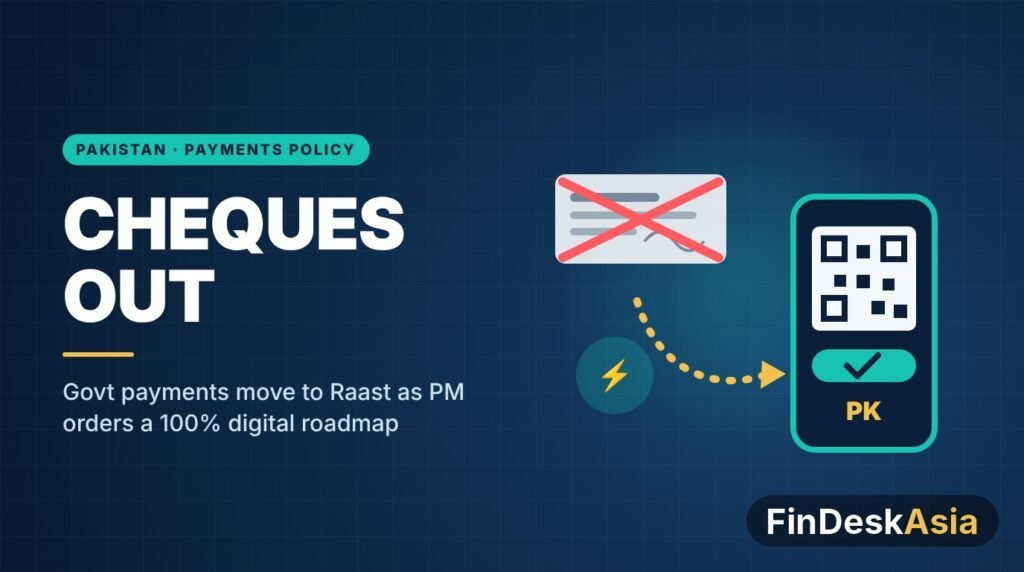
Pakistan Ends Cheques for Government Payments, Moves Them to Raast From 16 November
Pakistan’s government is about to stop paying its own bills by cheque. Prime Minister Shehbaz Sharif has ordered officials to draw up a roadmap, with firm targets and deadlines, for a fully digital payment system across the country, and set a date for moving a key stream of government payments onto Raast, the instant payment system run by the State Bank of Pakistan (SBP), the central bank.
Key facts
- At a meeting in Islamabad on Friday (6 November), the Prime Minister directed authorities to prepare a roadmap with clear timelines and targets for 100% digital payments nationwide.
- Cheque payments through the government’s Asaan Assignment Accounts end on 15 November; from 16 November, these payments will go only through Raast.
- Officials said most federal and provincial government departments are expected to finish digitising their payments by December 2026.
- All payments under the Benazir Income Support Programme (BISP), Pakistan’s main cash-aid scheme for low-income families, are now made through digital wallets, officials reported.
- Work is under way on a way to make digital payments in areas without internet access.
What is changing for government payments
Asaan Assignment Accounts are accounts that government offices use to make payments out of their budgets. Until now, many of these payments have been made by paper cheque, which is slow to clear, costly to handle and hard to track. Moving them onto Raast means money should move between bank accounts almost instantly, with a digital record of every transaction.
Reports say the government’s drawing and disbursing officers, the officials who approve and release payments in each department, have already been trained for the switch. The Finance Ministry was praised at the meeting for the progress made so far.
The Prime Minister also told officials to keep backing Raast QR, the national QR code that lets shoppers pay merchants straight from their bank or wallet app. He asked for a media campaign urging households to pay electricity and gas bills by scanning the QR codes already printed on those bills, and ordered that customer complaints about digital payment services be resolved quickly.
Why it matters
When a government stops writing cheques, it sends a strong signal to the rest of the economy. Suppliers, contractors and staff who receive government money will need bank accounts or wallets that can take Raast transfers, and that pushes more people and businesses into the formal financial system. Digital records also make it easier to trace where public money goes, which helps fight leakage and fraud.
The move to a 100% digital target, however, depends on more than payment rails. The Prime Minister himself tied the plan to wider internet coverage and easier public access to technology. That is why the promised offline payment option matters: without it, people in areas with weak or no connectivity could be left behind as cash and cheques are phased out.
For the region, Pakistan’s push echoes what other Asian governments have done with national instant payment systems and shared QR codes, such as India’s UPI and Malaysia’s DuitNow. These systems tend to grow fastest when the government itself becomes a heavy user, both for paying out money and for collecting bills and taxes.
What to watch
- Whether the switch of Asaan Assignment Account payments to Raast on 16 November runs smoothly, and how quickly provinces follow by December.
- The detail of the roadmap: which payments go digital first, the target dates, and how cash users are protected.
- Progress on the offline payment system and on QR bill payments for electricity and gas.
Read more: Pakistan: Single Window Plans Pre-Funded Wallet for Customs Duties and Trade Charges · DuitNow explained
Sources: The Express Tribune (November 2026) · SAMAA TV (November 2026) · Nukta (November 2026) · TechJuice (November 2026)
