
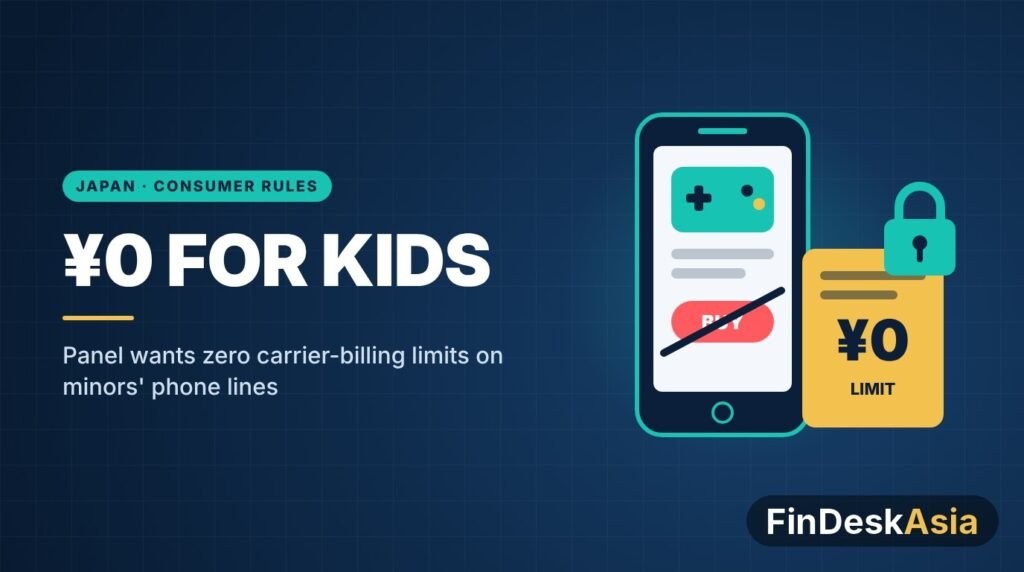
Japan: Consumer Panel Wants Zero Carrier-Billing Limit for Children After Game Charges
Japan is taking a hard look at carrier billing, the option that lets people put app, game and online shopping charges on their mobile phone bill. Consumer centres keep hearing from parents whose children ran up big in-game bills without asking, and a government advisory panel now wants phone lines used by minors to start with a spending limit of zero.
Key facts
- Consumer centres in Japan log around 6,000 complaints and enquiries a year linked to carrier billing. The yearly count stayed between about 5,400 and 6,200 from fiscal 2021 to fiscal 2025.
- Many cases involve children who made costly smartphone game purchases without their parents’ permission. Some older users said they did not know what they had paid for.
- A report by an expert panel of the Consumer Commission, an independent advisory body under Japan’s Cabinet Office, says lines used by minors should have a spending limit of zero in principle, or a very small amount.
- The panel also wants carriers to check whether a user can afford to pay before setting or raising a carrier-billing limit.
- It says carriers should not cut off phone service only because a customer has not paid for goods or services bought through carrier billing.
How carrier billing works, and where it goes wrong
In Japan, the big mobile operators let customers buy digital content, game items and even physical goods, then pay for them together with the monthly phone bill. It is quick, needs no credit card and is popular with young people. But it is also a form of credit: the carrier pays first and collects later.
According to the Consumer Commission panel’s report, published in September 2026, carriers usually switch on a spending limit automatically when a line is opened. The amount depends on the user’s age group, but even lines registered to minors can receive a limit by default. The panel warns that limits handed out without the user really noticing can become an entry point to debt. A child who knows the phone’s password can spend money the parents never agreed to.
The same report looked at other fast-growing ways to pay later. Complaints about Japan’s invoice-style “pay later” services reached about 67,000 in fiscal 2025, three times the level of fiscal 2021. Carrier billing produces far fewer complaints, but the panel says the risks are similar because both give consumers credit with little checking.
What the panel wants to change
The proposals borrow ideas from Japan’s existing rules on instalment sales and consumer lending, which already require lenders to check a borrower’s ability to repay. For carrier billing, the main ideas are:
- Affordability checks: a carrier would look at a user’s ability to pay before giving or increasing a spending limit.
- Child protection: a zero or very low limit on minors’ lines, plus better filtering and usage-control settings.
- Keep phones working: no suspension of mobile service just because a carrier-billing purchase went unpaid, as long as the phone charges themselves are paid.
- Wider oversight: bringing payment businesses that today need no registration under a registration or notification system.
Why it matters
Japan is pushing hard to raise cashless payments, and new ways to pay are multiplying: QR code apps, e-money, pay-later services and carrier billing. The panel’s work shows that regulators are now asking who protects the consumer when credit is built into these everyday tools, especially for children.
For the region, the debate is a useful signal. Carrier billing is common across Asia, where many people buy apps and game credits through their mobile operator rather than with a card. Rules on default limits for young users, affordability checks and fair debt collection could become a reference point for other markets that are expanding digital payments to younger and first-time users.
What to watch
- Whether Japan’s government turns the panel’s ideas into law, and how quickly.
- How the major mobile carriers respond, including any voluntary cuts to default limits for minors.
- Whether the push to register unregulated payment firms reaches pay-later providers and payment intermediaries too.
Related on FinDeskAsia: Japan: Digital Garage Adds Circle’s Arc for USDC Payments · How Malaysia’s payment system works
Sources: The Straits Times / Kyodo (November 2026) · Consumer Commission expert panel report (September 2026) · Tsuhan Shimbun (August 2026)
