
South Korea: Tech Firms Can Lead Won Stablecoin Groups if Banks Keep Majority, FSC Says
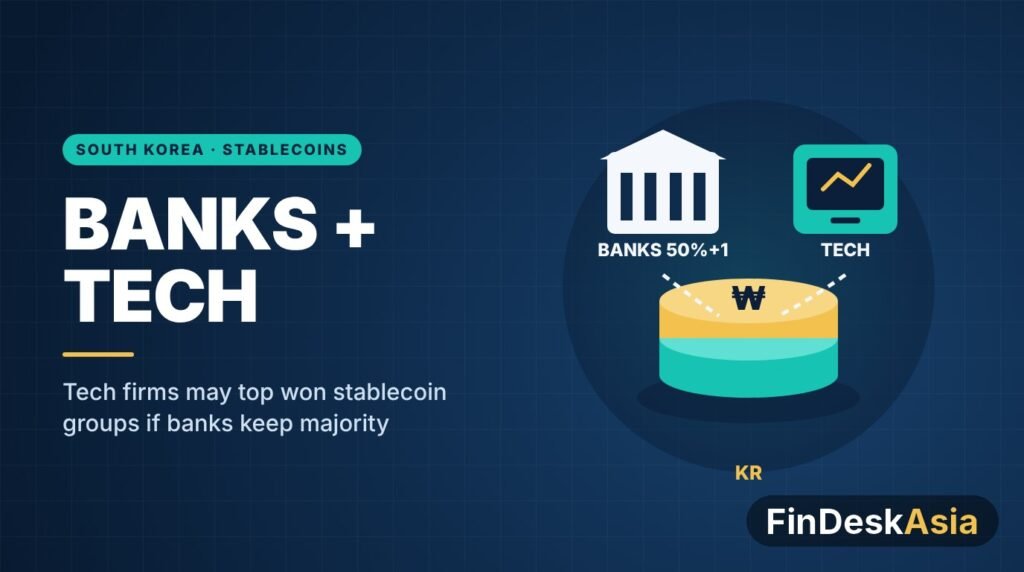
South Korea’s financial regulator has said for the first time, on the record, that a technology company may be the biggest single shareholder in a group that issues a won-backed stablecoin, as long as banks together own the majority. The comment shows how Seoul hopes to balance bank-style safety with the know-how of its big tech and payment firms, while the rules are still being written.
Key facts
- Yoo Young-joon, director general for digital finance policy at the Financial Services Commission (FSC), said on 12 November that no rule stops a tech company from being the largest shareholder in a won stablecoin consortium.
- The plan the FSC has discussed with lawmakers would have banks jointly hold at least 50% plus one share of an issuing consortium in the early stage.
- The FSC stresses that the ownership structure for issuers is not yet final; it will be set in the planned Digital Asset Basic Act, the second stage of Korea’s crypto law.
- The Bank of Korea, the central bank, backs a bank-centred model, while fintech and blockchain firms have urged lawmakers not to limit issuance to banks.
What the FSC is proposing
A stablecoin is a digital token that aims to keep a steady value, here one Korean won per coin, by holding safe assets in reserve. Korea has no licensed won stablecoin yet. The FSC wants the first issuers to be groups (consortiums) in which banks hold most of the shares, because banks bring capital and experience with anti-money laundering (AML) checks. Speaking at a stablecoin forum in Seoul’s Yeouido financial district, Yoo said the banks would take part as shareholders, not run the coins themselves.
That leaves room for a tech or payment company to own the largest single stake and help run the product, provided the banks’ combined holding stays above half. Yoo added that the pool of possible issuers could widen later, once early operating problems and legal gaps are dealt with. He also noted that stablecoins are mostly used for crypto trading today, but could move into trade payments and even purchases made by AI agents.
After the Digital Asset Basic Act is passed, the FSC expects to update the Electronic Financial Transactions Act and commercial laws so that stablecoins can be used in real shopping and business payments. A regulatory official at a separate National Assembly forum said stablecoin payment firms may need to protect customer funds, keep settlement records and offer dispute handling, much like today’s e-payment companies.
Why it matters
The debate decides who will control a potentially large new payment rail in one of Asia’s most connected markets. Fintech voices are pushing back. At the 12 November Assembly forum, Ryu Hong-ryeol, chief executive of VIDEX, argued that licences should depend on how well a firm manages reserves, issuance and redemption, not on whether it is a bank. He described banks and tech firms as complementary: banks look after reserves and liquidity, tech firms run the blockchain, keys and payment services.
The ownership question also touches big local deals. Korea’s Fair Trade Commission began a formal review on 10 November of Naver Financial’s planned share-swap takeover of Dunamu, the operator of the Upbit crypto exchange, looking at markets that include online payments and a future won stablecoin. Wallet and payment players such as Toss and Kakao have been preparing their own stablecoin services.
Korea is not alone in leaning on banks. Taiwan’s draft stablecoin rules would require a bank to own more than 25% of any issuer, and Hong Kong already licenses issuers through its central bank. For payment companies across Asia, the Korean model suggests a likely pattern: banks hold the reserves and the majority, while tech firms build the wallets and merchant links.
What to watch
- Whether the FSC sends the main provisions of the Digital Asset Basic Act to the National Assembly this month, and if the 50%-plus-one bank rule survives.
- The Fair Trade Commission’s decision on the Naver Financial–Dunamu deal and any conditions on stablecoin distribution.
- Which bank-and-tech consortiums form first, and whether Toss or Kakao take the largest stakes.
Related on FinDeskAsia: South Korea: Toss Builds Stablecoin Wallet and Payments, Aims for Early 2027 · Thailand: SEC Drafts 5 Million Baht Daily Cap on Stablecoin Deposits and Withdrawals
Sources: Seoul Economic Daily (November 2026) · crypto.news (November 2026) · Bloomingbit (January 2026) · Blockhead (November 2026)
