
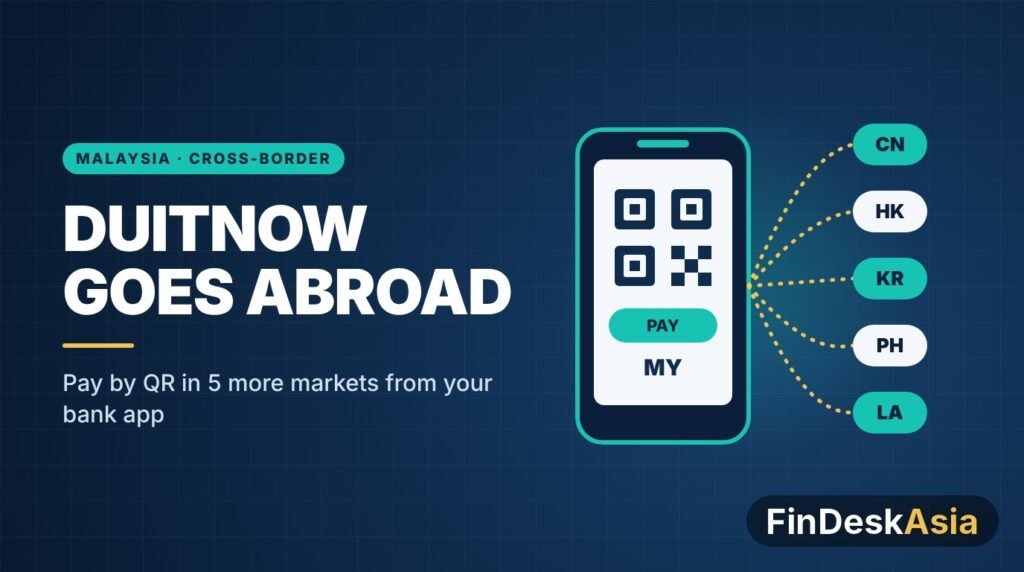
DuitNow QR Now Works in China, Hong Kong, South Korea, Philippines and Laos via Alipay+
Malaysians travelling to China, Hong Kong, South Korea, the Philippines and Laos can now pay shop bills by scanning a QR code with the banking app they already use at home. Payments Network Malaysia (PayNet), the national payments operator, switched on outbound DuitNow QR payments through Ant International’s Alipay+ network on 28 October 2026.
The launch flips an existing partnership around. Since November 2023, foreign tourists with Alipay+ partner wallets have been able to pay at DuitNow QR merchants in Malaysia. Now the traffic runs the other way too.
Key facts
- Five new destinations: China, Hong Kong SAR, South Korea, the Philippines and Laos. PayNet says more markets will be added over time.
- Three banks at launch: Maybank, CIMB and Hong Leong Bank, with Bank Islam due to join soon.
- No extra app: users scan a merchant QR code carrying the Alipay+ logo from inside their Malaysian banking app. No Alipay+ account is needed.
- Fast-growing demand: PayNet handled nearly 30 million cross-border transactions in 2025, about 150% more than in 2024, with much of the growth linked to China.
How it works
DuitNow QR is Malaysia’s national QR payment standard, run by PayNet and overseen by Bank Negara Malaysia (BNM), the central bank. Until now, Malaysians could use it abroad only in countries whose own national QR systems had been linked directly to DuitNow, namely Singapore, Thailand, Indonesia and Cambodia.
Alipay+ works differently. It is a gateway run by Ant International that connects many wallets and payment schemes to a large pool of overseas merchants. By plugging DuitNow into Alipay+, PayNet gives Malaysian bank customers access to shops that accept Alipay+ in the five new markets, without needing a separate bilateral link with each country.
At the till, the customer opens the QR function in their bank app, scans the Alipay+-branded code, checks the amount and merchant details, and confirms. Maybank says its MAE app shows the amount in both the local currency and ringgit before the user approves the payment. With the new markets, Maybank’s MAE Scan & Pay now works in eight overseas markets, adding to Singapore, Thailand and Indonesia.
PayNet chief executive Praveen Rajan said cross-border payments “should feel as familiar as paying at home,” and linked the move to BNM’s goal of faster and more efficient regional payments.
What it means for Malaysians
- Travellers: fewer reasons to carry large amounts of foreign cash or set up a foreign e-wallet before a trip to China or Seoul. Money is paid straight from a Malaysian bank account.
- Bank customers: the service sits inside the app people already trust, so there is no new account to open or verify. Customers of banks not yet on board will have to wait, or use other options such as cards and travel wallets.
- Banks: early movers such as Maybank, CIMB and Hong Leong Bank get a new way to keep overseas spending inside their own apps. Maybank says its total cross-border transactions grew almost 80% in the first nine months of 2026 compared with a year earlier.
- Costs to check: the launch announcements did not spell out fees or the exchange rates used, so travellers should compare the rate shown in the app with other options before paying.
What to watch
- Which other Malaysian banks, and e-wallets, join after Bank Islam.
- Which destinations PayNet adds next to the Alipay+ route.
- Whether banks publish clear exchange rates and fees for overseas QR payments.
Related on FinDeskAsia: DuitNow explained · ASEAN’s cross-border QR record
Sources: Lowyat.NET (Oct 2026) · ProductNation (Oct 2026) · Fintech News Malaysia (Oct 2026) · RiseMalaysia via Newswav (Oct 2026)
