
Malaysia Wants More Trade Settled in Ringgit and Partner Currencies Through BRICS
Malaysia wants more of its cross-border trade and investment to be paid for in ringgit and its partners’ currencies rather than in US dollars, and it plans to use its cooperation with BRICS to get there. The Ministry of Finance (MOF) set out the aim in a written reply to Parliament this week, but stressed that any shift has to be led by the market, not forced.
Key facts
- The MOF said Malaysia aims to expand the use of local currencies in cross-border trade and investment through BRICS cooperation.
- The stated goals are lower transaction costs, less foreign exchange (FX) risk, more resilience to external shocks and more payment options for businesses.
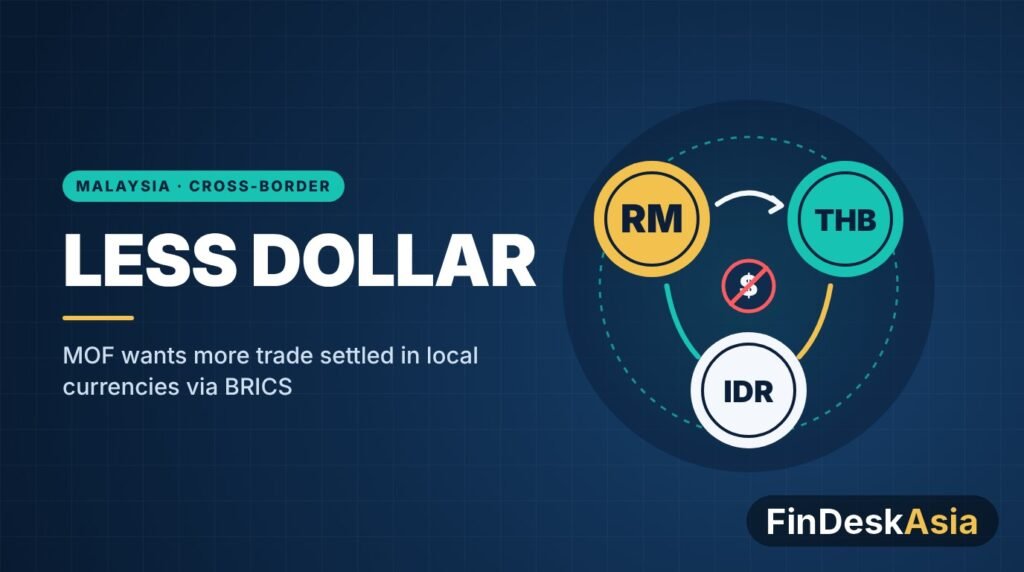
- Malaysia already has a renminbi–ringgit arrangement with China for bilateral trade, and a Local Currency Transaction Framework (LCTF) with Indonesia and Thailand.
- The MOF said major currencies still dominate global trade because of market size and wide acceptance, so expansion “must be market-driven” and backed by efficient cross-border payment infrastructure.
- The reply answered a question in the Dewan Rakyat (the lower house of Parliament) from Tan Sri Abdul Hadi Awang (PN-Marang).
What local currency settlement actually means
When a Malaysian manufacturer buys parts from Thailand today, the deal is often priced and paid in US dollars. That means two currency conversions: ringgit into dollars, then dollars into baht. Each step carries a fee and a spread, and both sides are exposed to swings in the dollar.
Local currency settlement cuts out the middle step. The buyer pays in ringgit or baht directly, through banks that are allowed to quote and clear that currency pair. Under the LCTF, run by Bank Negara Malaysia (BNM), Bank Indonesia and the Bank of Thailand, these banks are called Appointed Cross-Currency Dealers (ACCDs). The three central banks broadened the framework in February 2025 and added more ACCD banks in August 2025, including AmBank, Bank of China (Malaysia), OCBC Bank Malaysia, Standard Chartered Bank Malaysia and SMBC Malaysia.
Malaysia became a BRICS partner country on 1 January 2025. The MOF’s reply suggests the bloc is now being treated as another channel to build similar currency links with large trading partners, alongside the existing bilateral deals.
What it means for Malaysians
- Importers and exporters: SMEs that trade with China, Indonesia or Thailand can already ask their bank whether it is an appointed dealer and settle in ringgit, renminbi, rupiah or baht. Wider BRICS links could add more currency pairs over time, which may reduce conversion costs and make pricing more predictable.
- Treasury and FX planning: The MOF said wider local currency use could help firms manage their FX exposure better. A company that both earns and spends in the same partner currency can hedge less.
- Banks and payment firms: More trade in regional currencies needs deeper FX markets and better cross-border rails. The MOF itself linked expansion to “efficient cross-border payment infrastructure”, which points to more work for banks, PayNet and cross-border payment providers.
- Consumers: There is no direct change for shoppers or travellers today. Cross-border QR payments, which already let Malaysians pay abroad in ringgit through DuitNow, are a separate system, although they rest on the same idea of skipping the dollar.
The MOF did not give targets, timelines or trade figures, and it did not name new partner countries or any BRICS payment system. That makes the reply a statement of direction rather than a new policy.
What to watch
- Whether BNM signs new local currency settlement deals with other BRICS members or partners, such as India or Brazil, and adds more appointed dealer banks.
- Any data on how much Malaysian trade is now settled in ringgit and partner currencies, which would show whether market-led take-up is actually rising.
- How BRICS discussions on cross-border payment links develop, and whether Malaysia takes part in any shared infrastructure.
Related: How Malaysia’s payment system works · ASEAN cross-border QR payments
Sources: Malay Mail (Nov 2026) · Bernama (Nov 2026) · The Edge Malaysia (Nov 2026) · The Star (Aug 2025) · The Star (Dec 2024)
