
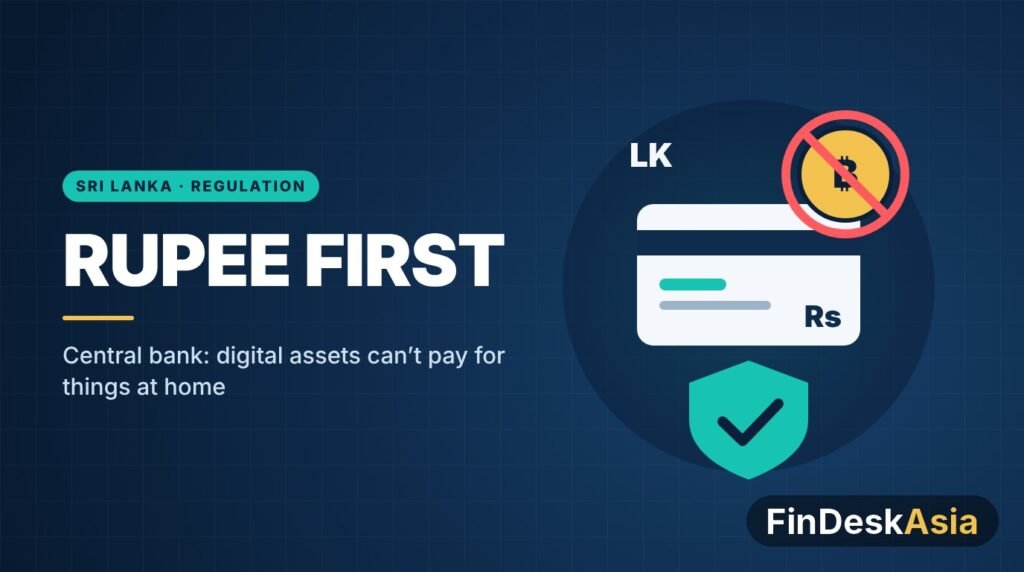
Sri Lanka: Central Bank Says Crypto Can’t Be Used for Payments Between Residents
Sri Lanka’s central bank chief has drawn a firm line around crypto and other digital assets: under the country’s current law, they cannot be used to make payments between people and businesses living in Sri Lanka. Speaking at the first Sri Lanka FinTech Festival in Colombo on 3 November, Governor Dr Nandalal Weerasinghe said the rule exists to stop digital assets from replacing the Sri Lankan rupee in everyday transactions.
The message was not a new ban. It restated the existing legal position, but it came with a broader warning that the country’s fintech push must stay inside limits that protect the rupee and the financial system.
Key facts
- Under Sri Lanka’s current legal framework, digital assets (also called virtual assets) cannot be used for payments between residents, the Governor of the Central Bank of Sri Lanka (CBSL) said.
- He said the position is meant to prevent the rupee being substituted in domestic transactions, and was a restatement of existing law rather than a new restriction.
- He listed fintech risks including cyberattacks, operational disruptions, fraud, data breaches, poor consumer disclosures and excessive leverage.
- CBSL pointed innovators to its existing FinTech Regulatory Sandbox, where eligible products can be tested under safeguards.
- The remarks were made at the inaugural Sri Lanka FinTech Festival in Colombo on Tuesday, 3 November 2026.
What the Governor said
Dr Weerasinghe framed the rule on digital assets as a question of monetary sovereignty, meaning a country’s ability to run its own currency and monetary policy. If payments inside Sri Lanka could move freely into crypto or other privately issued tokens, the rupee could gradually lose its role as the main means of payment at home. That would weaken the central bank’s grip on interest rates, inflation and the money supply.
He also warned that some digital assets swing sharply in price, exposing consumers to large losses, and can be used to move money illegally. In his view, digital assets need clear rules, proper safeguards and careful thought about their effect on the wider financial system before they play a bigger role. “Our approach must be proportionate, risk-based and forward-looking,” he said, adding that regulation must evolve as technology does.
The Governor went further than crypto. He flagged the growing reliance of banks and payment firms on a small number of technology providers as a new weak point, and said cross-border digital transactions can make supervision harder. “Financial stability cannot be compromised and must be preserved at all costs,” he said.
Why it matters
The speech sets the tone for Sri Lanka’s fintech ambitions just as the country tries to turn its recovery from the 2022 economic crisis into growth. The Governor said stability, rebuilt over the past three to four years of reforms, should now serve as a foundation for productivity and investment, not as an end in itself.
For fintech firms, the signal is mixed but clear. CBSL wants competition and new ideas, and named areas it sees as opportunities:
- open and interoperable financial services
- digital identity
- data-driven lending
- cross-border payment links
- digital investment products
Products built on existing rails such as LankaPay, the national payment network that runs Sri Lanka’s interbank transfers and QR payments, fit neatly into that picture. Anything that lets residents pay each other in crypto or stablecoins does not, at least under today’s law. Firms with new ideas are being steered towards the regulatory sandbox rather than straight to market.
The stance also stands out in the region. Several Asian central banks are exploring how regulated tokens could work alongside their currencies. Thailand, for example, has drafted rules for baht-backed stablecoins, and Malaysia is running ringgit stablecoin and tokenised deposit pilots. Sri Lanka, still rebuilding confidence in its currency, is choosing to protect the rupee’s place first and consider wider uses of digital assets later.
What to watch
- Whether CBSL or the government sets out a formal framework for digital assets, which the Governor said would need clear rules and safeguards.
- Which firms enter the FinTech Regulatory Sandbox next, especially in digital identity, data-driven lending and cross-border payments.
- How CBSL responds to the risk of critical financial services being concentrated among a few technology providers.
Related on FinDeskAsia: Thailand drafts baht stablecoin rules and Malaysia’s ringgit stablecoin and tokenised deposit pilots.
Sources: Newswire (November 2026); Daily Mirror Sri Lanka (November 2026); Newswire (November 2026).
