
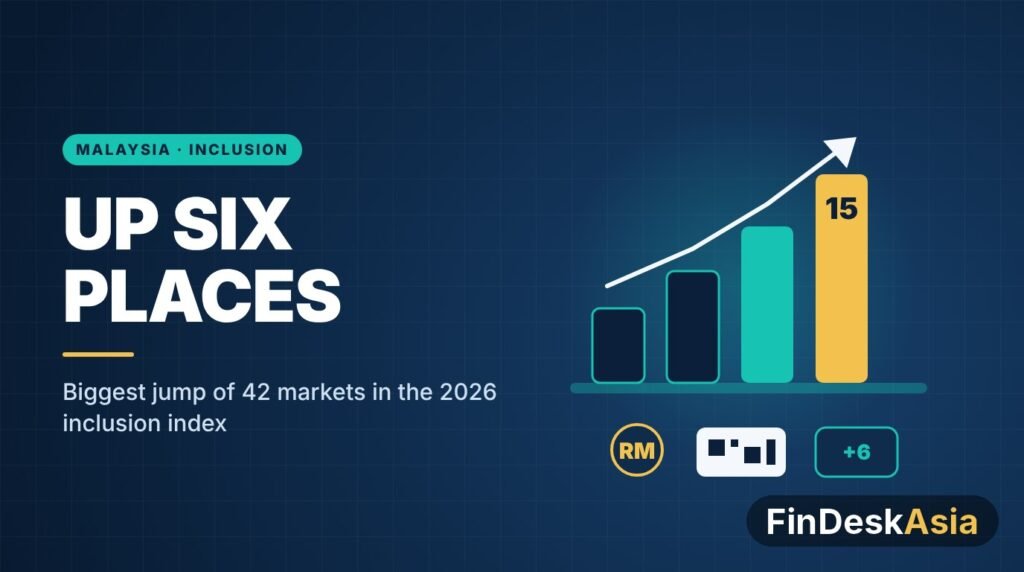
Malaysia Jumps Six Places to 15th in Global Financial Inclusion Index, the Biggest Gain
Malaysia has climbed six places to 15th in the 2026 Global Financial Inclusion Index, the biggest jump of any market in this year’s ranking. The index, produced by US-based Principal Financial Group with the Centre for Economics and Business Research (Cebr), a London consultancy, credits much of the rise to a stronger financial system and faster real-time payments.
Malaysia’s overall score rose 5.0 points to 58.2 out of 100, comfortably above the global average of 52.0.
Key facts
- Overall: Malaysia ranks 15th out of 42 markets, up six places, with a score of 58.2 (up 5.0 points year on year).
- Financial system pillar: 13th, up six places, scoring 59.5 (up 8.1 points) against a global average of 55.3 and a Southeast Asian average of 45.6.
- Real-time transactions: Malaysia rose seven places to 9th, helped by higher transaction volumes.
- Employer support: 5th in the world, up two places, with a score of 72.6 versus a global average of 65.7.
What the index measures
Financial inclusion means how easily people and small businesses can use everyday financial services: a bank or e-wallet account, payments, savings, credit and insurance. Principal’s index, now in its fifth year, scores markets on three “pillars” of support: from the government, from the financial system (banks, payment networks and access to credit) and from employers (for example, workplace savings and financial guidance).
Malaysia’s big move came from the financial system pillar, where its score jumped more than eight points. Within that pillar, the “real-time transactions” measure tracks how much money moves instantly between accounts. In Malaysia, that largely means DuitNow, the national instant-transfer and QR payment service run by PayNet, the payments network owned by Bank Negara Malaysia (BNM, the central bank) and the banks. The index also recorded smaller gains for access to capital, access to credit and business confidence, though it did not publish figures for these.
Munirah Khairuddin, chief executive of Principal Asset Management Bhd in Malaysia, said the country’s momentum shows how an established digital and fintech ecosystem can turn innovation into wider access, and that efforts to digitise financial services have brought more people into the system. She pointed to the national Digital Economy Blueprint, BNM’s Financial Sector Blueprint and the Securities Commission’s Capital Market Masterplans as the policy groundwork.
What it means for Malaysians
- Consumers: the ranking reflects what many already see day to day: instant transfers, QR payments at hawker stalls and digital banks that open accounts on a phone. A higher score suggests these tools are reaching more people, not just city users.
- Merchants and SMEs: the financial system pillar includes how well banks and lenders support small business growth. Malaysia’s gains on access to credit and capital are a positive sign for SMEs, though they still need to shop around and compare costs.
- Employers: Malaysia already ranks 5th for employer support, at a time when this pillar is weakening in most markets. Firms that offer financial wellness programmes, savings help or salary-linked benefits are part of why.
- Banks and fintechs: the result strengthens Malaysia’s pitch as a regional base for digital finance, but Principal stressed that keeping progress going will depend on good governance and strong consumer safeguards, including protection against online scams.
The weaker spot is still the government pillar. Malaysia slipped one place to 26th on government support, so the overall lead depends heavily on banks, payments and employers continuing to improve.
What to watch
- Whether DuitNow volumes and cross-border QR links keep growing fast enough to push Malaysia higher on real-time payments next year.
- How new digital banks and BNPL rules affect fair access to credit for lower-income households and micro-businesses.
- Whether scam losses and consumer protection rules shape how much Malaysians trust and use digital payments.
Read more: How Malaysia’s payment system works and DuitNow explained.
Sources: The Star (November 2026), The Sun (November 2026), Principal Malaysia, 2025 index release (October 2025).
