
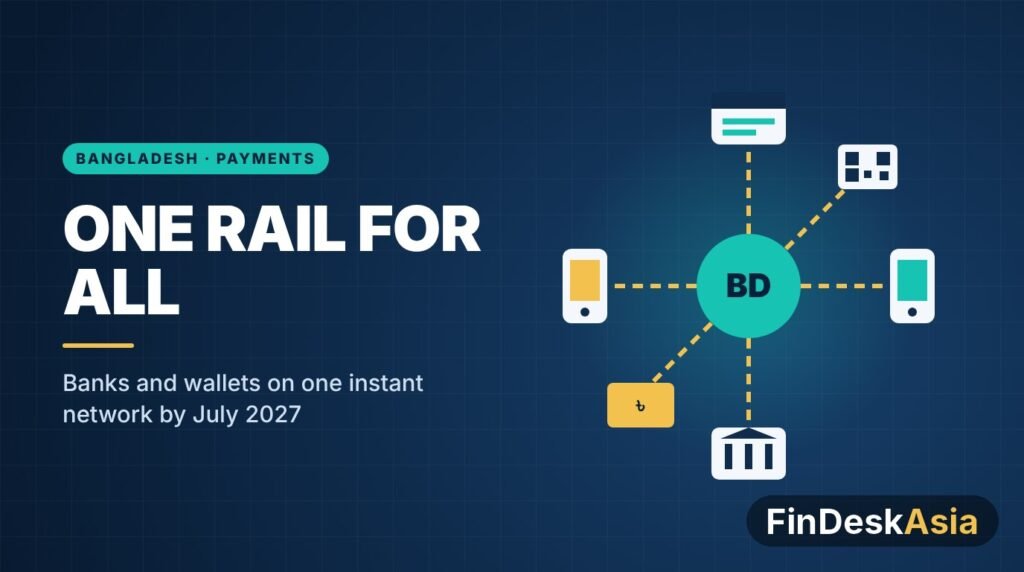
Bangladesh Plans One Instant Payment Network for All Banks and Wallets by July 2027
Bangladesh Bank, the country’s central bank, wants every bank and mobile wallet in the country on one instant payment network by July 2027. The planned Inclusive Instant Payment System (IIPS) would let people send money from a bank account or wallet to any other participating provider, instead of being stuck inside one company’s network.
Officials say an earlier push to link providers fell short because several large mobile money firms did not take part, so this time the aim is a single shared platform.
Key facts
- Bangladesh Bank is targeting a July 2027 launch for the IIPS, a single digital platform for banks, mobile financial service (MFS) providers and other financial institutions.
- It will support person-to-person transfers, business payments, shop payments and government disbursements.
- The Gates Foundation is giving technical support, and the system will use open-source software from the Mojaloop initiative.
- It builds on the National Payment Switch Bangladesh (NPSB), which has linked banks for ATM, POS and internet banking since 2012 but does not fully connect wallets and non-bank firms.
- An earlier interoperability rule capped fees, including VAT, at 0.15% for banks, 0.20% for MFS providers and 0.85% for payment service providers, with no charge to the recipient.
What is changing
Bangladesh already has a busy digital money scene. Mobile wallets are widely used, but moving money between a wallet and a bank, or between two different wallets, has not always been simple. The NPSB switch handles transfers among participating banks, yet it was never built to fully include mobile money operators and other non-bank players.
Bangladesh Bank tried to fix this before by ordering banks, MFS providers and payment service providers to connect and by setting maximum fees. According to Bangladesh Bank Executive Director Md Sirajul Islam, that arrangement did not work as hoped, which is why the central bank now wants a more coordinated technical framework that puts all institutions under one system.
The new platform will run on Mojaloop, free open-source software designed to help countries build shared, low-cost instant payment systems. Islam said customers would no longer be limited to their own bank’s or provider’s network.
Why it matters
For ordinary users, a single network means a farmer with a wallet could pay a shop that banks elsewhere, or receive a government allowance straight into whichever account they use. For businesses, the central bank expects lower cash-handling costs and cleaner records. For the government, it could make it easier to pay salaries, subsidies and social safety net benefits digitally.
There is also a cost saving for the state. Islam said more digital payments would reduce what the government spends on printing, transporting, storing and managing banknotes in taka, the local currency.
Remittances are a big part of the story. Policy Research Institute of Bangladesh (PRI) chairman Dr Zaidi Sattar has noted that remittances make up about 6% of GDP. In July, PRI launched a Gates Foundation-backed research project on how the IIPS could be used for cross-border remittances. Researchers say direct links between institutions could speed up how money is shared out at home, and that connecting to approved overseas networks could help money from workers abroad reach accounts or wallets faster and more cheaply. That would require international partnerships, foreign exchange compliance and settlement deals.
That last point is relevant for Malaysia, which hosts many Bangladeshi workers who send money home. Any future link between the IIPS and authorised overseas networks could affect how remittance firms serving that corridor operate, although no such link has been announced.
Bangladesh also joins a growing list of Asian countries building one national instant payment rail, similar in spirit to India’s UPI, Malaysia’s DuitNow and Pakistan’s Raast.
What to watch
- Whether the biggest mobile wallet providers commit to join, since their absence sank the last attempt.
- What fees the IIPS will charge, as affordable pricing is named as a condition for success.
- Formal guidance from Bangladesh Bank and any cross-border remittance partnerships ahead of July 2027.
Related: DuitNow explained · How Malaysia’s payment system works
Sources: Bangladesh Post (November 2026) · Views Bangladesh (November 2026) · Bonik Barta (November 2025)
